The Birds Still Sing
Time was when people around the world heard the word Ireland and thought "bombs". Those fiery days ended with the successful peace process in Northern Ireland.
It was the first great 'event' of the new Irish nation. It was the international 'coming out' of the young free state and was embraced by the people of Dublin with an unmatched intensity. It included the greatest gathering of Irish people in a century. It launched the national radio station and showcased the high tech capabilities of the Irish people. It reconciled the divided nation still reeling from a civil war only a decade in the past.
"It" was the 31st International Eucharistic Congress held in Dublin in 1932.
The world was in deep depression. In Germany, Adolf Hitler had not yet risen to power nor had Franklin Roosevelt become President of the US. Ireland was poor, poor, poor - an agrarian nation only recently risen to independence. The former combatants of the short but intense civil war were still bitter. But, for one glorious week, the nation transcended its divisions and poverty.
1932 was the 1500th anniversary of St. Patrick's arrival in Ireland and so it was to the Emerald Isle that prelates and visitors from around the world ventured. Ireland welcomed the Congress with an unprecedented display of fervour.
A Eucharistic Congress does what it's name suggests. A gathering celebrates the Eucharist, the sharing of bread and wine in memory of Christ's last supper. The high point of any Roman Catholic Mass is the display of the consecrated host, blessed by a priest and now the body and blood of Christ. And the point of a Eucharistic Congress is to gather ordinary worshippers, priests, nuns and monks to contemplate and adore this holy mystery. In Protestant terms, it's a 'revival', a celebration of the presence of God.
The first Eucharistic Congress was a purely local affair held in France in 1881. But, the idea took hold and soon national and then international events began to be scheduled. And when Ireland was chosen to organise and host such a huge international conclave, the nation took the event to heart.
In Dublin, every little neighbourhood built a shrine, vying to outdo the neighbours down the street with the glory of their display. To broadcast the proceedings, the government built the first high powered radio station in Ireland. This facility was the start of RTE, still the national broadcaster some 80 years later.
This wasn't the only cutting-edge technology showcased by the young nation. They pulled out all the stops: spectacular lighting effects, the largest personal-address (PA) system in the world and even sky writing. Every major street in the city of Dublin was decorated with fresh flowers. Every major building was lit at night with spotlights and coloured lamps. Flags and bunting bearing the papal colours of yellow and white transformed the city. Georgian Dublin became for this one week a giant festival arena.
Processions filled the streets during the week of the Congress. Special masses were offered for the women and children of Ireland. Around the country, thousands thronged open altars erected specifically for the event. The high point was the Papal address to over 100,000 of the faithful gathered in Phoenix Park to celebrate the Eucharist. Pope Pius XI addressed the crowd live from Rome over the finest PA system on the planet. Count John McCormack sang and hundreds of Bishops from around the globe marched in their colourful robes between thousands of black clad priests.
The Congress was a healing for the young nation. Millions participated in the various events, local or national. Many remembered it always as a high point in their lives. The colour, the pageantry, the gravity of the Mass all served to highlight the deep faith of the Irish people.
In June 2012, the 50th International Eucharistic Congress returns to Dublin. The world has changed; Ireland has changed. But, what hasn't altered is the warm welcome that participants will experience during their visit. We at Number 31 invite you to join us during this special week
The 50th International Eucharistic Congress website gives many more details.
Most of us have managed to learn a few common texting abbreviations.
LOL - Laugh Out Loud. And then there's Dublin LGBTQ. What the...? Or perhaps that should be WT!
The Dublin Lesbian Gay Bisexual Transgender and Queer Pride Festival (DLGBTQPF!) has become a major annual event in Dublin. The high point of the festival is the Gay Pride Parade through the centre of Dublin. This is the second biggest annual parade in the city after the Saint Patrick's Day Parade (SPDP?).
Dublin and Irish society has come a long, long way from the days when Oscar Wilde was prosecuted for 'gross indecency' by a court of law and sentenced to two years hard labour. When Wilde sought to make a statement, he was shouted down with cries of "Shame". Nowadays, the LGBTQ starts its historic walk of Gay Dublin at Oscar's statue in Merrion Square - a five minute walk from Number 31.
Parades, walks, concerts, family outings, debates, music - this massive happening involves tens of thousands of people. Everyone's invited. And, of course, N31WBTAMA - Number 31 Will Book Tickets And Make Arrangements.
For the events programme and more information, see the Dublin Pride Website.
Jerusalem Brought to Ireland
All Irish high crosses are representations of holy sites in Jerusalem. Carved in the medieval period, roughly 700 to 1200 AD, they are the most impressive sculptures from the early Middle Ages this side of Byzantium.
Start at the base of the cross. It is always stepped. Why? Because during late Roman times, pilgrims climbing the hill of Golgotha did so on a series of well built steps. So, the bottom of every high cross recreates in miniature the approach to the spot where Jesus was crucified.
Atop the sacred hill in Jerusalem, a great cross was erected. So too, the Irish versions are topped by the symbol of the crucifixion. A ring of stone connecting the arms to the upright length of the cross creates the characteristic outline of the “wheeled” or Celtic Cross. This ring, too, harkens back to the time of Rome.
When a general won a battle, his standard was erected outside his tent. It bore the general’s shield surrounded by a laurel wreath. When Constantine won the battle that made him undisputed Emperor of Rome, he directed that the Greek letters Chi-Ro, representing ChRist, be placed within a wreath at the top of the imperial standard. The scholarly consensus is that the Celtic Cross is a recreation in stone of this ancient Roman military decoration.
In those early days, the tomb of Jesus was enclosed in a small house, and later by a domed shrine. We know this because pilgrim souvenirs from the time depict a dome atop the holy sepulchre. Sure enough, intact Irish crosses are topped with a small shingled building or a beehive shaped dome.
Tourist Tat
The original great cross, steps and tomb in Jerusalem were totally demolished by an invading Persian army in the 7th century. The only surviving evidence of the Roman places of pilgrimage are those souvenir medallions purchased by visiting tourists. It’s amazing to think that ancient tourist tat is our main source of evidence about these sites. Perhaps that medal of Lourdes in your dresser will be all that is left for future historians trying to reconstruct Bernadette’s grotto.
Next time you come upon a Celtic Cross, take a good look. Many of the more modern versions filling local graveyards are simplified versions of their medieval ancestors. But, some of the more faithful representations recall monuments found in Jerusalem nearly two millenia ago. Each Celtic Cross faithfully recreates Golgotha; each is a pilgrimage in miniature.
Ahenny Crosses
The National Museum of Ireland, Collins Barracks, in Dublin currently has a major display of High Crosses. You can take the LUAS tram from O'Connell Street right to the museum or Number 31 will happily book a taxi. Yes, right here in Dublin you can take a pilgrimage to ancient Jerusalem!

Amazing bumblebee facts: The buzzy little critters' brains work five time faster to process images than do people. They literally see quicker than we do, which is mighty useful for avoiding obstacles and fly swatters.
Worker bumblebees can find their way back to the nest from up to 5 miles away. These ladies don't get lost.
Cuckoo bumblebees closely resemble their chosen species. They invade a nest, kill the Queen and her larvae and lay their own eggs. The poor worker bees then raise the 'cuckoo's' offspring without knowing the difference.
That loud buzz is more important than stripey patterns for warning away birds. Faced with a split second decision whether to eat the buzzing critters, even a birdbrain learns discretion.
Ireland has 20 native species of bumblebees. Honeybees, by contrast, were imported to the island by humans.
Male bumblebees are produced by the Queen only before the annual mating period. Upon birth, the lads are shoved from the nest. In the words of one (female) researcher: "The guys don't do housework, they don't help raise the kids - and they have only half the genes."
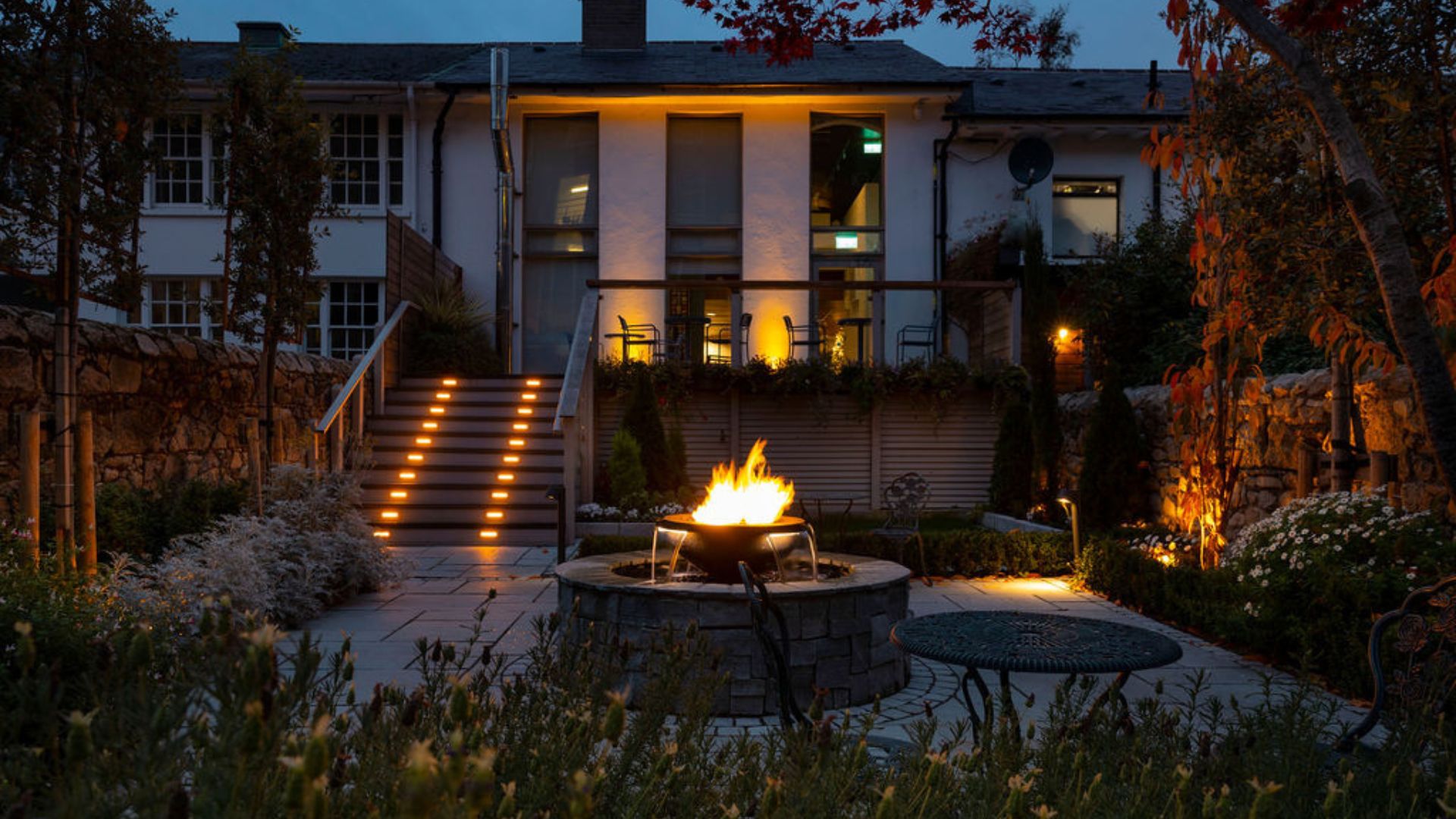
Dublin hides a thriving natural habitat for birds, bees and other critters. Behind those impressive Georgian facades lie huge stretches of garden courtyards. The flowery oasis at Number 31 is particularly lovely and restful - a perfect spot to while away a drowsy summer hour to the buzz and drone of native bumblebees.
Page 1 of 2 pages Next Page »
Number 31, 31 Leeson Close, Dublin 2, Ireland | Telephone: +353 1 676 5011 | Email: info@number31.ie | site by Bookassist
Show Background